
Liquidity Packets: Reading Hidden Accumulation Before the Candle Confirms
TL;DR — Liquidity packets are bursts of participation that can reveal accumulation or exhaustion before the candle confirms. They're not a chart pattern — they're a tape-reading discipline that combines CVD slope, refresh behaviour at a price level, and the relationship between trade size and book absorption. The trader who reads packets correctly often gets a 30-60 second head start on the directional move. The trader who reads them as noise pays the full retail entry cost.
Most retail traders process trade-by-trade activity as a stream of randomness. Prop traders process it as a sequence of decisions made by participants whose intentions can be inferred from how their orders interact with the book. The difference is the discipline of clustering trades into "packets" — bursts of related activity at a level — and asking what each packet tells us about who's still left to buy or sell.
What a liquidity packet actually is
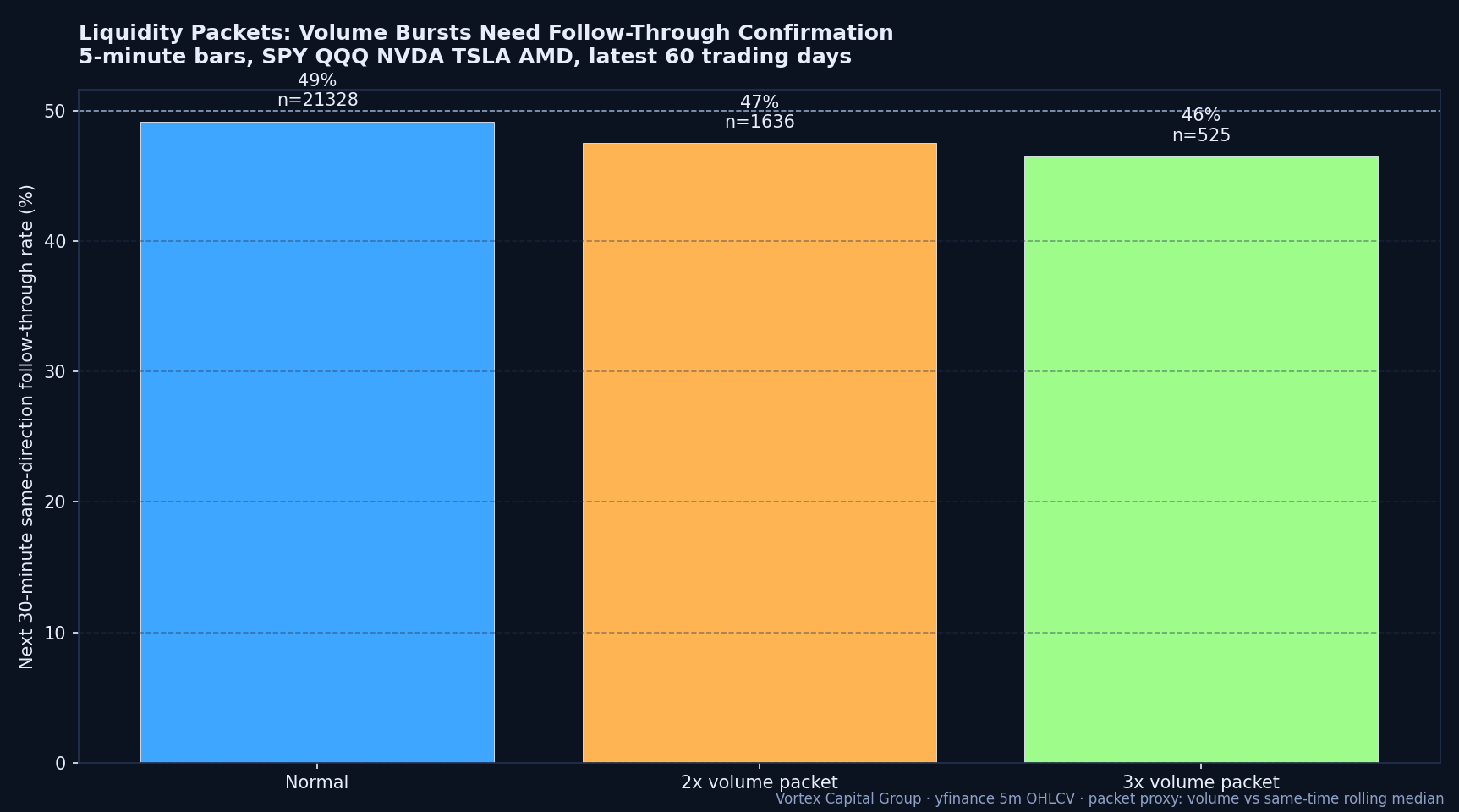
- A burst of trades at one price level (typically 5-30 prints in 5-15 seconds), often by multiple participants.
- Refresh behaviour on the offer or bid as the packet works through it — does the level hold and re-quote, or does the side break?
- CVD response in the same window — is cumulative delta confirming the direction of the packet, or is it diverging?
- Trade-size distribution within the packet — mostly small (retail / algo slicing) vs occasionally large (institutional probe) vs a mix.
Accumulation vs exhaustion — same packet, different read
Accumulation packet: burst of buying at a level, CVD expanding with the packet, offers refreshing immediately after being lifted, no aggressive seller appearing on the next probe. Result: the level holds; the next push higher tends to follow within minutes.
Exhaustion packet: burst of buying at a level, CVD flattening or rolling over despite the buying, offers stop refreshing after being lifted, aggressive seller starts hitting the bid as the packet completes. Result: the move is finishing; the next direction is usually down.
The chart looks similar in both cases — a small consolidation at a high. The order flow reads completely differently. This is why Reading Level 2 like a prop trader is essential for packet-reading; the book context separates the two interpretations.
How we operationalize packets
Vortex Flow visualises packet structure in real time — CVD trace, heatmap accumulation, ladder refresh, and aggressive-side bias all on one workstation. The trader who's already reading these inputs by feel has the framework; the tooling just makes it consistent. The trader who's reading candle close patterns will keep arriving late.
Packets matter most during the high-volatility windows where the per-second decision cost is highest — the 09:30 open, the close auction, and the VIX-stressed risk-off windows. They matter less during lunch, where the lunch reversal pattern gives a cleaner timing read.
Related
Volume Shock Without Sponsorship · Reading Level 2 · 10:30 VWAP Decision Point · Smart Routes vs Manual Routes.
Joining the desk
Traders who already process trades as clustered participation rather than random ticks are operating at the packet-reading level. The trader application takes about ten minutes.
#LiquidityPackets #OrderFlow #CVD #Level2 #TapeReading #DayTrading #PropTrading #VortexFlow #VortexCapitalGroup
Trade with the desk behind the research
Vortex Capital Group gives qualified traders DMA via Sterling Trader Pro, multi-vendor HTB locates, smart and dark-pool routing, and an 80%+ monthly profit share.
Apply to Trade