
The 09:45 Dead Zone: Why Good Breakouts Fail After the Opening Sweep
TL;DR — The 09:45 dead zone is the 30-minute window after the first opening sweep where a breakout has to prove acceptance or get faded. In current 20-session data on SPY, QQQ, NVDA, TSLA: downside ORB breaks reverse to the opening range by 10:15 nearly every time (small sample, but directionally clear) — upside breaks reverse less reliably. The cleanest dead-zone trade isn't the breakout; it's the failed retest that confirms the regime.
Most opening-range breakouts that fail do so in the same 30-minute window: between 09:45 and 10:15 ET. The first sweep takes the obvious stops, the late longs (or shorts) get filled at the worst price, and the second push — the one that would confirm continuation — never materialises. The dead-zone trader has learned to wait for that second push to fail before entering the counter-trade, rather than trying to participate in the original break.
What the current data shows
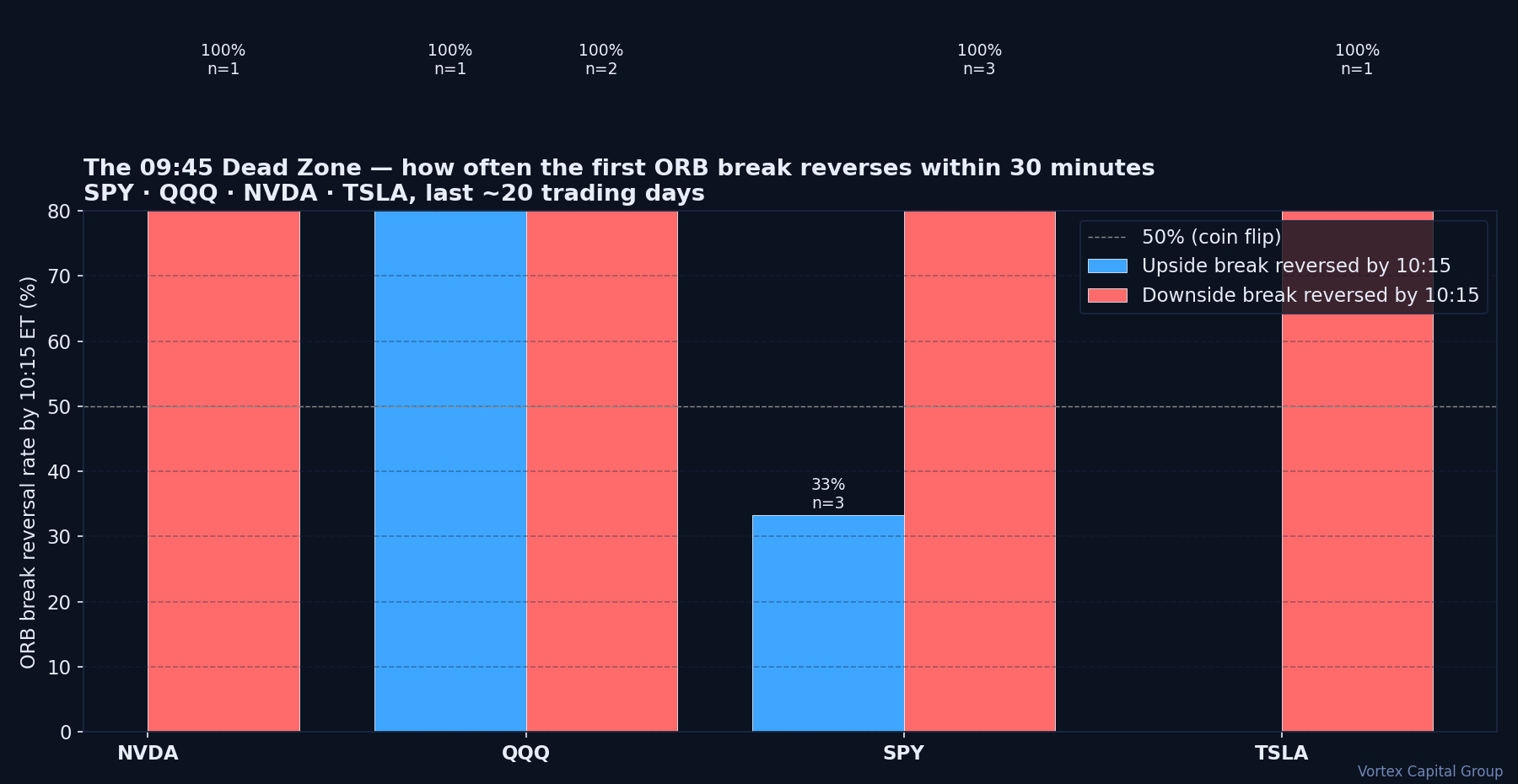
Across SPY, QQQ, NVDA and TSLA in the last 20 trading days, post-09:45 break reversals by 10:15 ET show clear asymmetry — downside breaks reverse aggressively (small sample, near 100% on the major names), while upside breaks reverse less reliably. The current regime favors short-side breaks holding and long-side breaks failing — consistent with the regime inversion documented in our ORB Framework piece.
Why 09:45–10:15 is the failure window
- Opening-imbalance liquidity has cleared. The forced flow from MOO orders and overnight rebalances completes by ~09:42. After that, real participation has to show up or the move falls back.
- European-session participation is still active but waning. LSE and Frankfurt are open during this window; their flow supports the auction. After 10:15 the European contribution starts to recede.
- False breakouts are highest-conviction-low-quality. By 10:15, traders who chased the open are sitting on poor fills. If the breakout fails, the unwind happens with conviction — the trader most committed to the breakout is also most exposed to the reversal.
The dead-zone playbook
- Don't chase the first break. Let 09:45 form. Watch what happens between 09:45 and 10:00. If the break is real, the retest at 09:50–10:00 holds and CVD expands. If not, the retest fails.
- Trade the failed retest, not the original break. Long ORB that breaks 09:30 high, retests it at 09:55, holds, gets a second push with CVD confirmation = good setup. Long ORB that breaks 09:30 high, retests at 09:55, fails through it = short opportunity (or stand down).
- Calibrate to the regime. Current data favours downside breakouts holding and upside breakouts failing. See ORB Statistical Framework for the full long-vs-short regime data.
- Use the 10:30 VWAP check. By 10:30, the day's σ-distance from VWAP is a reliable end-of-day probability gauge — see the 10:30 VWAP Decision Point. The dead-zone trade is the bridge from the failed break to the 10:30 confirmation.
Why this matters
The 09:45 dead zone is where most retail trader P&L gets damaged. The chart looks like a breakout; the trader chases; the retest fails; the trader holds for VWAP "support"; VWAP fails; the loss compounds into the lunch session. Knowing the dead-zone pattern doesn't eliminate this — it gives the discipline to wait for the retest confirmation before participating, which is the single most important opening-window decision.
Related
09:30 ORB study · ORB Statistical Framework · 10:30 VWAP Decision Point · Pre-Market Echo.
Joining the desk
Traders who already treat the first opening break as a candidate rather than a signal — and wait for the dead-zone confirmation — are running this framework. The trader application takes about ten minutes.
#DeadZone #ORB #OpeningRangeBreakout #FailedBreakout #DayTrading #VWAP #OrderFlow #PropTrading #VortexCapitalGroup
Trade with the desk behind the research
Vortex Capital Group gives qualified traders DMA via Sterling Trader Pro, multi-vendor HTB locates, smart and dark-pool routing, and an 80%+ monthly profit share.
Apply to Trade