
DMA vs Retail Broker Execution: Where Your Edge Actually Goes
TL;DR — Retail execution drains edge in the windows where active traders actually make money. SPY median 1-minute range expands from ~2.2 bp at the lunch low to ~4.9 bp at the 09:30 open and ~2.7 bp at the close. NVDA goes from 5 bp to 10 bp+ in the same windows. Every basis point of spread the retail wholesaler takes back is a basis point off the trade's expectancy — and the cost compounds during exactly the windows where the chart is calling for participation. DMA isn't a status symbol; it's the layer that lets us choose how to interact with that liquidity instead of inheriting the average.
Most traders over-study entries and under-study execution. They know where they want to buy, where they want to stop, and where they want to scale. Then the actual order goes through a routing process the trader cannot inspect or control. The order arrives at a wholesaler. The wholesaler internalizes against an inventory book that includes retail flow from a dozen other brokers. The fill prints — sometimes inside the spread, sometimes at the inside, sometimes at the touch — and the trader moves on without ever asking what just happened.
Retail broker execution can look acceptable in a slow tape. The weakness appears in the moments active traders care about most: opening drive continuation, halt reopens, thin-liquidity reversals, crowded shorts, high-beta earnings names, and any minute where information is moving faster than the back-end router.
Where the edge actually leaks
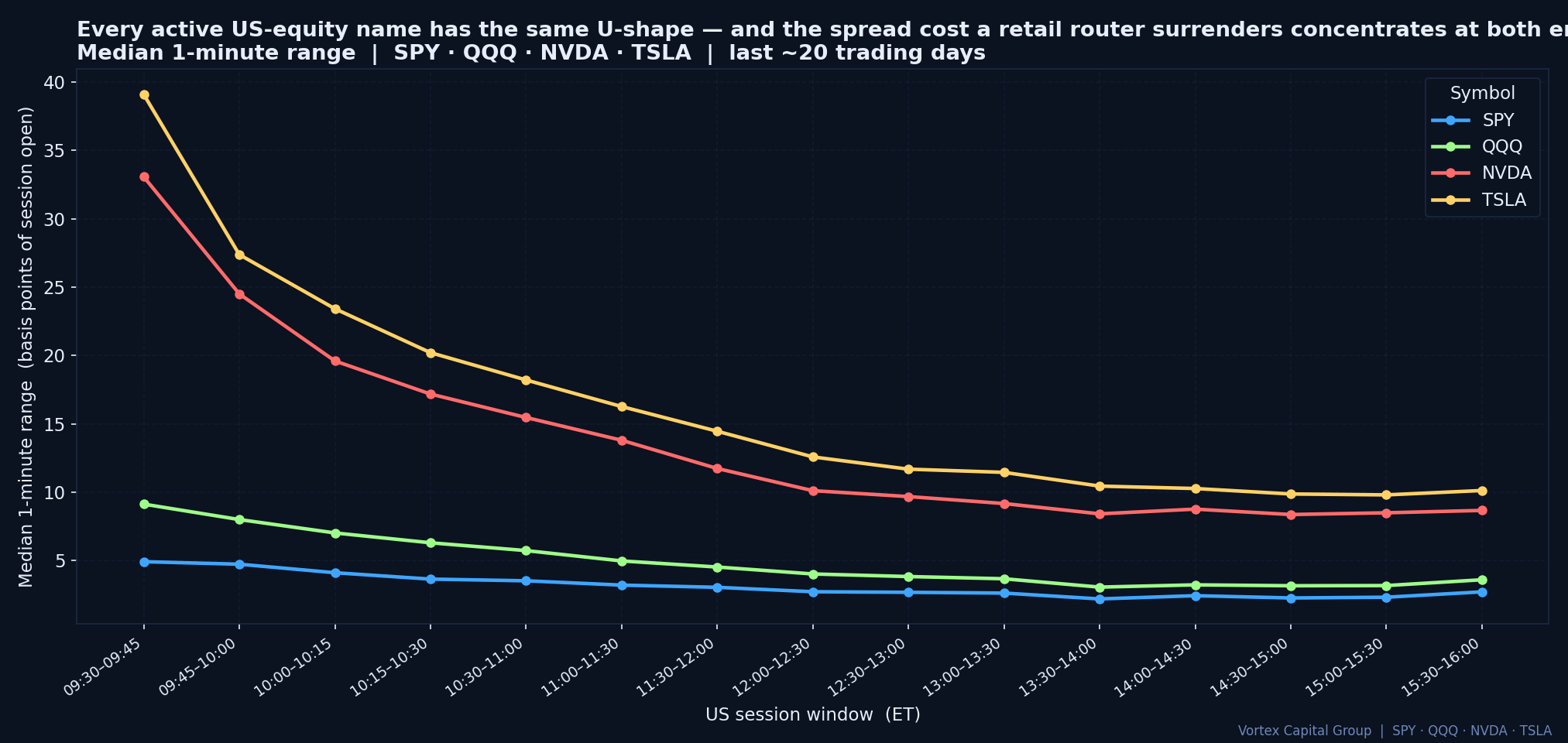
The chart above shows the median 1-minute range across the four most-traded US equity names by 15-minute window. The U-shape is the empirical signature of the routing problem:
- Spread control. A trader may believe the strategy has a 20-cent expected move, but if the entry routinely gives up 3–6 cents through blunt routing, the strategy has already changed. On SPY at 09:30, the 1-minute range medians 4.9 bp — roughly $0.30 per $600 share. A retail wholesaler that gives back 2–3 bp in price improvement "savings" is taking the rest.
- Timing. A delayed cancel-replace, a slow stop-loss adjustment, or a smart-router decision that waits too long can turn a valid trade into a poor one inside thirty seconds. In the 09:30–09:45 window, where information density is at its daily peak, that thirty seconds is the entire trade.
- Venue choice. Lit markets, ATS venues, midpoint pools, and dark pools each handle different order intents. A smart router is a probability-weighted compromise. For active traders, that compromise is sometimes exactly right and sometimes exactly wrong. We covered the venue selection logic in detail in our smart-routes vs manual-routes piece and the dark-pool liquidity decision framework.
- Short-side access. A short setup that cannot be located before the trigger is not an executable setup. Retail platforms often make this problem invisible until the moment the trader tries to act. By then, the trade has already been telegraphed by the visible attempt to short. The hard-to-borrow infrastructure piece walks through the math.
Reading Rule 605 and Rule 606 like a desk does
SEC Rules 605 and 606 require brokers to publish execution-quality and routing-disclosure reports. Most retail traders ignore them. We don't. The disclosures show where each broker routes its non-directed orders by venue (Rule 606) and what the execution quality looks like statistically — effective spread, price improvement, fill rates, speed (Rule 605).
The honest read on the major retail brokers is that their Rule 606 reports show high concentration to a small set of wholesalers — Citadel Securities, Virtu, Susquehanna, G1, Two Sigma. That's not necessarily bad for a passive investor. For an active day trader, it means every marketable order routes to a market participant who profits from the difference between the inside quote and the wholesaler's effective fill price. The wholesaler's stated "price improvement" is real — but it's measured against the inside, not against where the order would have filled with direct venue access and an ISO-modifier ladder.
Active traders need to read the reports for one specific thing: how does the broker's average effective spread compare across symbol size buckets, particularly in the 100–500 share range during the 9:30–10:00 window? That's the empirical answer to "is my edge surviving the broker."
DMA is a feedback loop, not a status symbol
Direct Market Access matters because it turns execution into something the trader can plan, review, and improve. Every order has an intent — urgency, queue, footprint reduction, or completion — and the route should match that intent. With DMA, the trader decides whether the order should seek liquidity, provide liquidity, use smart routing, interact with dark or midpoint liquidity, or take the inside aggressively. With retail routing, the wholesaler decides. The decision the wholesaler makes is correct on average and wrong in exactly the cases where the trade needed something specific.
Our pre-order checklist
- Route: is this a lit sweep, a passive queue entry, a midpoint attempt, or a smart route? The answer should be settled before the order is sent, not chosen by the broker.
- Slippage: where does this order become wrong even if the chart still looks right? Maximum acceptable price is a number, not a feeling.
- Borrow: is the locate real, what is the borrow rate, what happens if shares are recalled? Without these answers, the short side of any setup is theoretical.
- Flow: do CVD, VWAP behaviour, heatmap liquidity and the price ladder confirm the trade or warn that the move is crowded? Our Vortex Flow stack carries this layer.
- Review: did the strategy fail, or did execution turn a valid idea into a bad trade? This is the single most common diagnosis gap on retail-routed P&L.
The DMA workflow in our actual day
- Urgency trade: define maximum acceptable price before sending the order. ISO modifier to ensure marketable execution at the limit. We covered the auction-window economics in our opening range break study.
- Passive trade: define queue logic and cancel condition before joining the book. Peg-to-primary or peg-to-mid orders carry their largest edge when the inside is stable.
- Dark-aware trade: define whether footprint reduction is worth the risk of partial or missed fill. The answer is venue-specific — IEX, MS Pool, Sigma X, UBS ATS each behave differently.
- Short trade: solve borrow before the level, not after the price has already confirmed. The trade plan and the locate plan are the same plan.
Where retail routing surrenders the most edge
Read the chart again. The first 15 minutes of the cash session, the last 30 minutes, and any session where VIX is elevated — these are the windows where the bp cost of routing concentrates. They are also the windows where the active trader is doing 70% of the day's P&L work. The retail wholesaler is built to optimize the average case across thousands of customer orders per second. The active trader is trading the cases that are explicitly not average. The two models conflict, and the active trader is the one who pays for the conflict.
What the desk is built around
Vortex Capital Group's stack — DMA through Sterling Trader Pro, the Vortex Flow order-flow analytics, the Vortex Edge scanner, four-vendor HTB locate access, and multi-clearing redundancy — is the operating layer that turns execution into something measurable. Our Sterling Trader Pro DMA workflow piece walks through the hot-keys / routes / risk-control surface in detail. The PFOF tax study quantifies the exact basis-point cost retail flow surrenders.
Joining the desk
We want traders who already understand that execution is part of strategy — who can explain why they routed the way they did and what they'd change next time. The trader application takes about ten minutes; every serious candidate is reviewed personally within five business days.
#DMA #ExecutionQuality #DayTrading #PFOF #OrderRouting #SterlingTraderPro #Rule605 #Rule606 #HardToBorrow #PropTrading #USEquities #VortexCapitalGroup
Trade with the desk behind the research
Vortex Capital Group gives qualified traders DMA via Sterling Trader Pro, multi-vendor HTB locates, smart and dark-pool routing, and an 80%+ monthly profit share.
Apply to Trade